
Warning: Attempt to read property "ID" on null in /home/davidmor/eoop.davidmorgen.org/wp-content/plugins/subscribe-to-comments/subscribe-to-comments.php on line 212
Income Differences Within Elite Colleges
Putting the notion of gender differences aside, it’s important and worthwhile to acknowledge why elite institutions attract so many students from higher incomes in the first place, and why, regardless of their goals to attract global communities, they tend to fail to admit large numbers of low-income students into their student bodies.
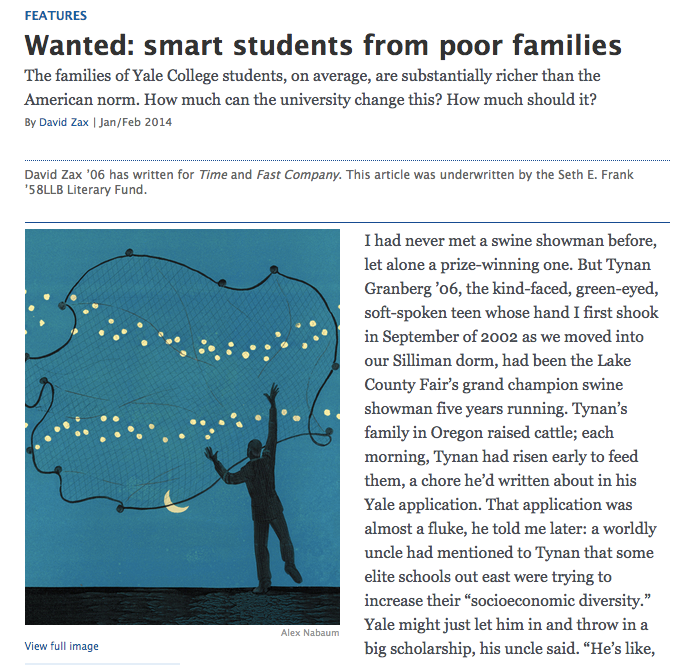
In 2014, Yale alumnae Robin Hayes wrote an article in The Atlantic titled, “Why Ivy League Schools Are So Bad At Economic Diversity.” It was essentially a response and criticism of the article that Yale Alumni Magazine published a month prior titled “Wanted: smart students from poor families.” Yale’s explicit outreach to its wealthy Alumni base served as their announcement that their goal is to “seek smart students from poor families,” as the author describes these low-income students as “out there – but hard to find.” In her article, Hayes states that the author unknowingly reveals how the privileged trustees, alumni and administrators at Yale show the obstacles as to how this goal of attracting poor students will never come true.
Yale defines their high-achieving student body as having “high GPAs in ‘demanding’ high schools and extraordinary character-defining extracurricular activities.” The high-income students that typically make up the Yale student body come from affluent feeder schools that have curriculums which include small classrooms, teach critical thinking skills, leadership qualities and that encourage participation; these students come from high schools where they had access to athletics, creative activities, well-resourced libraries, and heavily connected college counselors. However, the students that Yale says it is trying to attract more are the students who can’t afford to attend those affluent, higher-income schools and therefore many of them deal with harsh conditions like gun violence, overcrowding, and a curriculum that emphasizes obedience over excelling. It is the students that achieve academically in these poor public schools despite their difficult surroundings that are rarely seen as high achievers by top schools such as Yale; as Hayes states, “The collegiate honor roll lacrosse captain easily surpasses the Benjamin Banneker high B+ student who lives in a shelter and works at Target after school to help out her single mother and younger siblings.”
Just as Yale’s perception of the high achieving student is cockeyed, so too is their definition of a low-income family. The alumni magazine article notes that 69% of the freshmen at that time were from families with annual incomes higher than $120,000 in a country where the median household income is $52,700, and the international median household income is $10,000. Perhaps if Yale re-evaluated what a low-income versus a high-income student was, their goal of reaching more students who don’t come from the wealthiest high schools will be met. Hayes also suggests in her conclusion that the elite colleges are overvaluing the quality of the students from higher income families and undervaluing lower-income applicants.
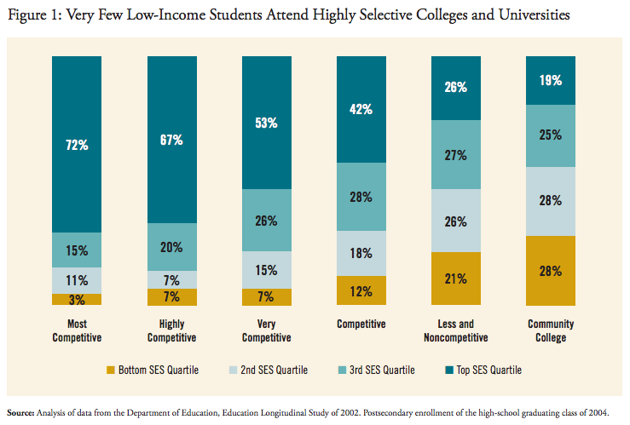
Although Yale is only one example of an elite university, it serves as a microcosm for the phenomenon of the top colleges and universities who have contributed to the well-known trend of rich kids attending the best schools in America. In delving into the Equality of Opportunity project, and specifically in income-differences within varying leveled institutions, it’s important to look at the possible reasons behind why there is an income difference at these elite colleges and universities.
